
Roadmap 2026
Fluxer is now in public beta, thanks to the many early supporters who have paid for Plutonium Visionary!


We now also have a new hire beyond myself :D
 Stevie Bonifield
Fluxer is now in public beta, thanks to the many early supporters who have paid for Visionary! We sold around 1,000 copies at $299 each before stopping sales.
I’ve published a blog post that covers the journey that brought us here, the technical decisions we made along the way, the philosophy behind Fluxer, and why something like Fluxer is needed right now:
 Hampus Kraft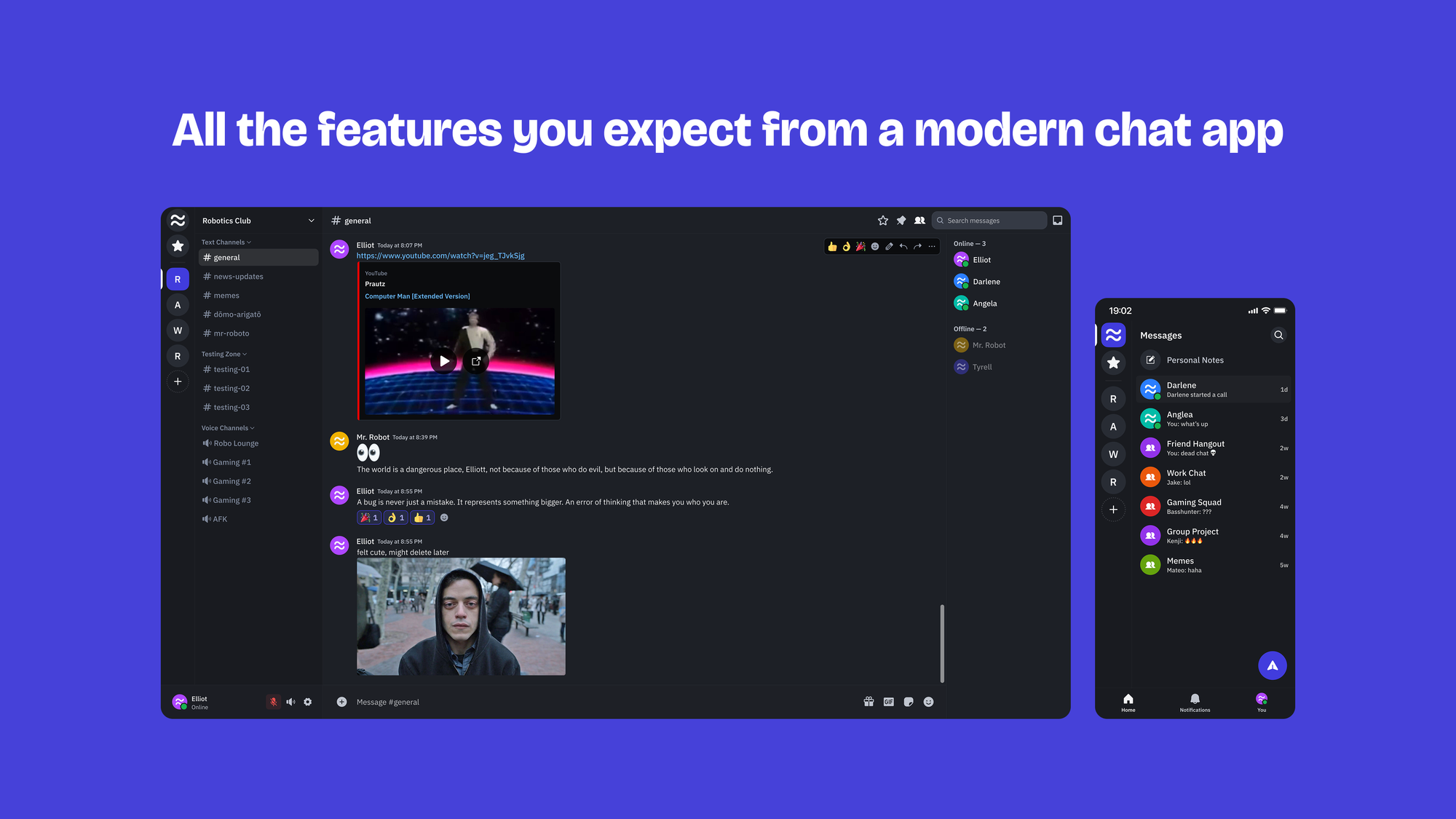
Fluxer's feature coverage is already quite high, but there's still plenty of work to do. I'm just one person, but with financial support and code contributions from the community, we can go a long way.
#1: Native mobile app
Due to time and hardware constraints (I've got an M1 MacBook with a measly 8GB of RAM, and I don't have the financial means to upgrade yet), Fluxer currently only has a web-based PWA (progressive web app). You can install it to your home screen on mobile devices and get offline push notifications.
But it's far from the desired endgame. Most people don't particularly enjoy this experience, and the web limits what you can achieve. The app doesn't feel especially native on mobile web, and you also can't integrate with CallKit or similar for voice and video. It kinda sucks, and it's just an interim solution.
If you'd like to sponsor my hardware upgrades so I can get started, or help with the development itself, you can either donate to Fluxer or get in touch at hampus@fluxer.app.
#2: Threads and forums
I didn't include this feature in the public beta because I want to do it right. If you have issues with how other platforms implement threads and forums, let me know – and I'll make sure Fluxer's implementation improves on them.
#3: Federation
Federation is in development! When it arrives, OAuth2 will be used to authenticate via your home instance when interacting with other instances, and no instance will store data from outside its own.
Even before true federation is available (where you need just a single identity), we'll work towards enabling your client to maintain multiple WebSocket connections across separate backends and merge everything in a single view, or just provide instantaneous account switching with notifications in real-time across all your accounts, depending on how you want to use it.
To solve this for the web client (native apps would be able to maintain multiple connections without an issue), we're thinking about providing a companion browser extension. Previously, we considered an encrypted relay system, but we're not sure if this is feasible on the long term, even with community-hosted infrastructure to spread the load.
#4: Publish forums to the web
 Amanda Silberling
As part of #3, I'd also like to add the ability to publish forums to the open web. That way, people can discover, archive, and access discussions without logging in.
With LLMs, Sellis said, Discord could take a long, meandering conversation and turn it into “something that could be more sharable and syndicated across the web.” However, he said that he and his team hadn’t “seen a solution that we feel great about yet.”
On Fluxer, LLMs shouldn't be involved in this at all. I want to embrace the open web by supporting RSS and Atom feeds, and without altering anyone's content. After all, this feature would apply only to forum threads, not to the unstructured firehose of conversation in regular text channels.
#5: Community discovery
In addition to #4, I'd like Fluxer to offer both an in-app and a public (no login required) way to discover Fluxer communities that are published to the web, regardless of where they're hosted.
This discovery system would ultimately need some top-level moderation by Fluxer Platform AB. People can, of course, still use regular search engines, but this could further improve content discoverability.
#6: Slash commands and UI kit
This is also a feature I wanted to implement correctly rather than rushing a half-baked implementation. The goal is to achieve feature parity with Discord and more (slash commands, modals, components, and interactions). Ultimately, you get to decide with your feedback how you want this to work!
#7: Emoji and sticker packs
A lot of Discord users can probably relate to joining loads of communities just to use their emojis and stickers globally. Fluxer would instead let you save emoji and sticker packs created by others directly to your account, if you prefer.
#8: E2EE in DMs
Platforms like Matrix do offer E2EE, but the complexity of the protocol and its client implementations often comes at the expense of what people actually want.


What most people want isn't privacy maximalism, but a reliable, feature-complete, non-E2EE Discord alternative: fast clients, good search, profiles and statuses, custom emoji, straightforward roles and permissions, solid voice and video, and practical moderation tools that work.
That's where Fluxer's priorities lie. Adding E2EE to text messaging would significantly increase complexity for an already complex system, and I want to focus first and foremost on building a great, stable community chat app that's on par with Discord.
Earlier plans included a "secret chat" feature — purely ephemeral conversations where nothing is stored on the server besides encrypted, expiring blobs for attachments. This approach sidesteps most of the complications E2EE introduces around search, cross-device sync, and key management: if everything is ephemeral, the problem largely resolves itself. It also avoids the misleading perception that Fluxer is fully E2EE — the kind of confusion that has plagued Telegram whenever it advertises E2EE support.
That said, a lot of people aren't happy with the secret-chat approach. So while I don't want this to steal focus from the broader roadmap, we will accept pull requests that introduce E2EE for one-to-one and small-group DMs, provided they don't complicate the rest of the stack. E2EE for voice and video calls is already underway. But it's ultimately up to instances whether or not they will allow this feature being used!
E2EE for voice and video calls is already underway.
#9: Creator monetisation
Fluxer could let fans pay to unlock roles and access to a creator's exclusive community content. That could be permanent or time-limited, billed as a one-off purchase or a recurring subscription. Creators could also sell event tickets for time-boxed sessions, where a ticket (or temporary role) unlocks specific text and voice channels for the duration of the event.
From a platform operator's perspective, this is the ideal model: charge a small, transparent fee on each transaction (for example, 5–10%) and stay competitive with alternatives like Patreon. Patreon has been moving towards Discord-style community features, while Discord has experimented with Patreon-style monetisation, but those efforts have been uneven (and in Discord's case, still limited in availability and focus). This would be a great revenue stream to still be able to focus on the app and not need to rely on Plutonium as much!
 Mia Sato
Focusing on this for the Fluxer.app instance would also provide reassurance to users where the value comes from. Fluxer wouldn't need to invent the content people pay for since creators already do that. Fluxer "just" needs to provide the best real-time communication platform (text, voice, and video) and the creator tools that make audience-building and community management easier. That means the free tier could be subsidised to a larger extent.
If you'd like to use Fluxer as an integrated Discord + Patreon solution, and you already have a large audience you'd be willing to bring over, get in touch. We're looking for early partners to test creator monetisation features, and we can offer a lower platform fee for partners. Email partners@fluxer.app.
And more!
Polls and scheduled events, profile connections, a theme marketplace, broader global voice server coverage, stage channels, activity sharing (what game you're playing, what song you're listening to), streamer mode, folders to organise your DMs, popping calls out into their own desktop windows, soundboard clips, community templates, public profile URLs, and improved noise cancellation through Krisp – there are so many features, big and small, that Fluxer wants to implement eventually.
You can influence the roadmap by joining the Fluxer HQ community, submitting issues in the GitHub repository, emailing me, or supporting Fluxer in any of these ways:
- Donate any amount, as an individual or a business.
- Purchase Plutonium on the main Fluxer.app instance.
- Spread the word about Fluxer with friends and on social media.
But why?
Why use Fluxer when Discord is free and works well? And, realistically, why trust a new product that could disappear next week?
If Discord does what you need, and you're fine relying on a proprietary, investor-driven platform and have no concerns about their upcoming IPO, then you probably don't need Fluxer. I'm not trying to compete with Discord's network effect by fearmongering.
 Julie Bort
Fluxer is for people who want different incentives: free, open source, self-hostable software, with an optional hosted version run by an independent, European-owned provider.
Fluxer is also among the closest, if not the closest, replications of the state-of-the-art feature set and UX that we've all grown accustomed to on centralised proprietary platforms such as Discord or Slack.
Fluxer's success isn't contingent on Discord getting worse. I'm building something I believe the tech community has been missing, where people are generally more willing to switch to a credible alternative if one shows up.
Discord's network effect is hard to beat head-on, so I'm focusing where switching is already plausible: technical users and communities that value control and transparency, and want software they can run on their own terms. Others may simply prefer a European-owned instance run without exploiting its users, with clearer incentives.
Fluxer is free and open source (AGPLv3), and the core principle is simple: it's always the same software. The business model is built around giving people multiple ways to support Fluxer, depending on how they want to use it:
- First, we run an official hosted freemium instance. It's free to use and it has a Plutonium subscription for users who want higher limits. We also offered a limited-time lifetime Visionary plan for early supporters. This sold out quickly at 1,000 copies ($299 each)!
- Second, we accept donations from individuals and organisations who self-host Fluxer and still want to contribute to its development. You can also support Fluxer regularly via GitHub Sponsors.
- Fluxer doesn't currently offer managed hosting, but if there's interest, I'm happy to offer managed instances of the Fluxer Server and the LiveKit voice server, including managed backups. Just let me know!
If you don't like the free tier limits on the hosted instance and you don't want to pay for Plutonium, you can always run your own instance. Fluxer is committed to not paywalling parts of the software or requiring licence key checks. It also won't force upgrades to unlock quotas on software you run yourself. No SSO tax!
Closing thoughts
Phew – if it isn't obvious, I care about this a lot. If you do too, I'd really appreciate your support: code contributions, one-off or recurring donations, or even a quick word of encouragement to @fluxer.app on Bluesky. With your help, Fluxer can grow into a chat platform that puts your interests first.
I want Fluxer to stay fully independent and bootstrapped. That means relying heavily on donations, whether one-off or recurring. It also means leaning on revenue from early supporters (Visionary helped immensely!), as well as any revenue Plutonium generates on the hosted instance.
Got questions or concerns, or interested in partnering with Fluxer? Whether you're a content creator, run an open source project, manage a community of any size, or work at a CDN or trust and safety vendor, you can reach me directly at hampus@fluxer.app. If you're a fellow independent, bootstrapped, privacy-first alternative to the mainstream, or you're in the press, I'd love to talk too.
We've already come a long way, and I hope you've liked what you've seen so far. With your help, Fluxer can become a serious FOSS alternative to Discord.
See you in the Fluxerverse!
A DeLorean time machine lifts off, heading for new adventures.
Ready to get started? Download the app or open Fluxer in your browser to start connecting with your communities.
